
Our Heavenly Team
Our Heavenly Team
During the celebration of our marriage, there will be a particularly special moment: the Litany of the Saints.
The word litany comes from the Greek litaneia, meaning a supplication or earnest prayer. Since the earliest centuries of the Church, Christians have used this form of prayer to ask for the intercession of those who already live in the presence of God.
When we invoke the saints, we do not worship them or place them in the place of God. Rather, we do something very similar to asking someone to pray for us. The difference is that these friends already behold God face to face and remain united with us in the communion of the Church.
In a wedding, the Litany reminds us that no one is called to live the vocation of marriage alone. Love grows best when accompanied by inspiring examples, by intercessors who pray for us, and by a community that helps us remain faithful to the path we have begun.
For this reason, before we pronounce our “I Do”, we wish to entrust our lives to this small heavenly team. Some of these saints are closely connected to our personal story. Others reflect what we hope to live as a married couple: faith, family, care, service, mission, and trust in God.
In the end, each of them helps us better understand the theme we have chosen for our wedding:
“A threefold cord is not easily broken.”
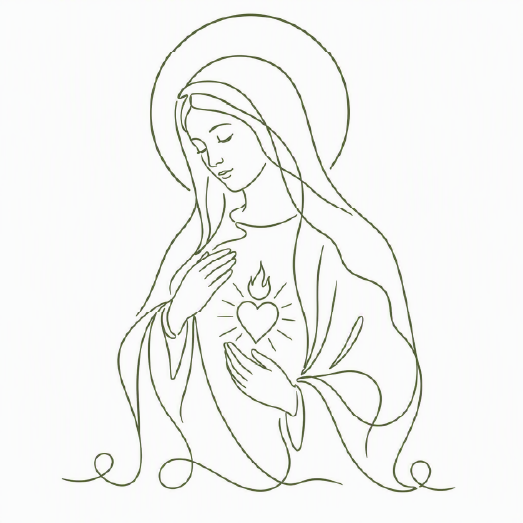
Holy Mary, Mother of God
Mary holds a unique place in the history of salvation. Chosen to be the Mother of Jesus, she teaches us that true greatness is born from trust in God and a willingness to respond to His call.
As Christians and as Portuguese, we feel a very special connection to the Blessed Virgin Mary. Under the title of Our Lady of Fátima, so deeply woven into the faith of the Portuguese people, Mary continues to be a sign of prayer, hope, and trust in God's promises.
Her presence in our litany also carries a deeply personal meaning. By coincidence—or perhaps by providence—Diogo was born on 13 May, the day on which the Church celebrates Our Lady of Fátima.
Mary is also present in some of the most important places along our journey of faith. The Parish of Our Lady of Pena, whose parish church is the Church of Our Lady of Pena, was the place where Diogo rediscovered and deepened his spiritual life. Also part of this parish is the Chapel of Our Lady of the Immaculate Conception of Carreira, dedicated to the Immaculate Conception, Patroness of Portugal—a place that played a particularly special role in this journey and where some of the most significant moments of this return to faith were lived.
Thus, under the titles of Our Lady of Fátima, Our Lady of Pena, and Our Lady of the Immaculate Conception, we recognise the constant presence of the same Mother who accompanies us throughout our story.
As we invoke Holy Mary, Mother of God, we entrust to her our marriage, our future family, and all the dreams we carry in our hearts. We ask her to accompany us as she accompanied Jesus, to teach us to listen to God's will, and to help us keep Christ always at the centre of our threefold cord.
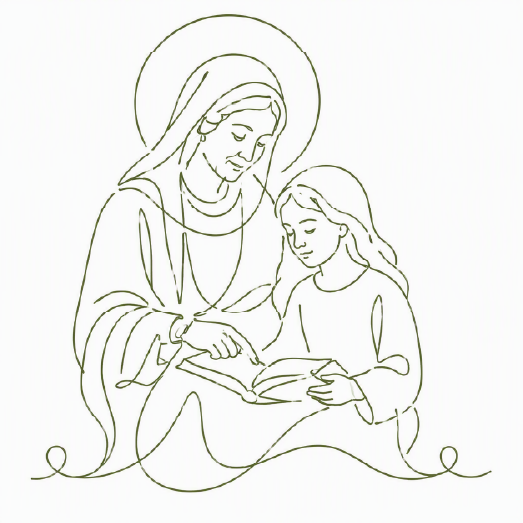
Saint Anne
Traditionally recognised as the mother of the Virgin Mary, Saint Anne represents the importance of family roots and the transmission of faith from one generation to the next.
Her presence in our litany also carries a deeply personal meaning. It was in the Parish of Our Lady of Pena, located on historic Calçada de Sant’Ana in Lisbon, that Diogo rediscovered and deepened his life of faith and drew closer once again to the life of the Church. For this reason, the name of Saint Anne evokes not only a saint to whom we are devoted, but also a place that marked an important stage in this spiritual journey.
In invoking her, we wish to give thanks for the love, guidance, and example we have received from our parents and grandparents. We also have a particular concern for the elderly, who are so often overlooked in a society that tends to value youth above all else.
Saint Anne reminds us that the experience, memory, and wisdom gathered throughout a lifetime are a true treasure.
We ask for her intercession for all the grandparents and elderly members of our families; for those who cared for us before we were able to care for ourselves; and for all who continue to teach us, through their example, the true meaning of faithfulness and perseverance.
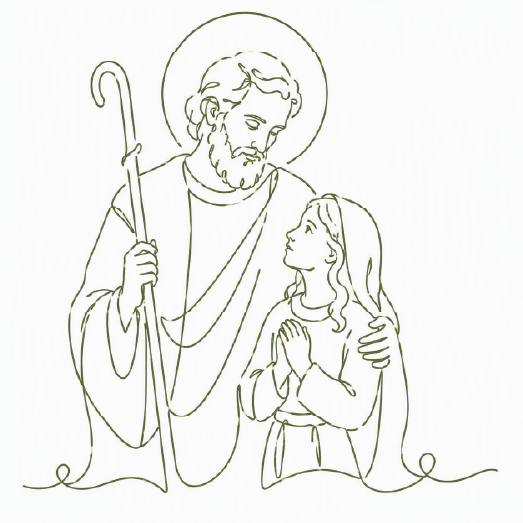
Saint Joachim
As the husband of Saint Anne and the father of the Virgin Mary, Saint Joachim is a model of trust in God, family fidelity, and quiet perseverance.
Together with Saint Anne, he is traditionally venerated as a patron saint of grandparents and the elderly. His life reminds us that every stage of life possesses its own dignity and that a person's worth never diminishes with age.
We have also chosen him because the reality of older generations is a cause that touches us deeply. In them, we recognise a source of wisdom, memory, and love that deserves to be cared for, protected, and cherished. In a world that too often views the elderly as a burden, Saint Joachim reminds us that they are, actually, among the pillars upon which families and communities are built.
As we invoke Saint Joachim, we ask for the grace to build a family that honours its roots, cares for older generations with gratitude, and learns from those who have gone before us on the journey of life and faith.
May Saint Joachim and Saint Anne teach us to build bridges between generations, so that our threefold cord may be strengthened not only by the love we live in the present, but also by the inheritance of faith, values, and witness that we have received from those who came before us.
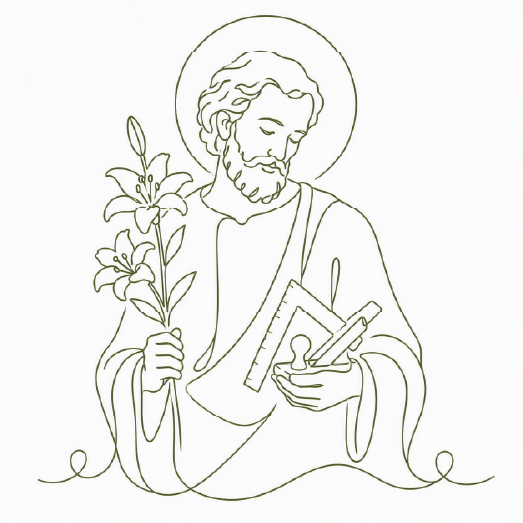
Saint Joseph
Saint Joseph is the just man, the faithful husband, and the guardian of the Holy Family. His life speaks to us of a love that is quiet, practical, and deeply faithful.
We do not know many of his words from the Gospels, but we do know his actions: he welcomed Mary, protected Jesus, worked to provide for his family, and obeyed God even when the path before him was difficult to understand.
We have chosen him because marriage is built in much the same way: through simple acts, faithful decisions, and a love lived out in everyday life.
Saint Joseph reminds us that holiness within the family is not achieved only through great moments, but above all through the daily ability to care for, protect, and serve one another.
As we invoke him, we ask that he help us build a home filled with trust, hard work, tenderness, and fidelity. May he teach us to live our marriage with the same humility and selfless devotion with which he served the family entrusted to him by God.
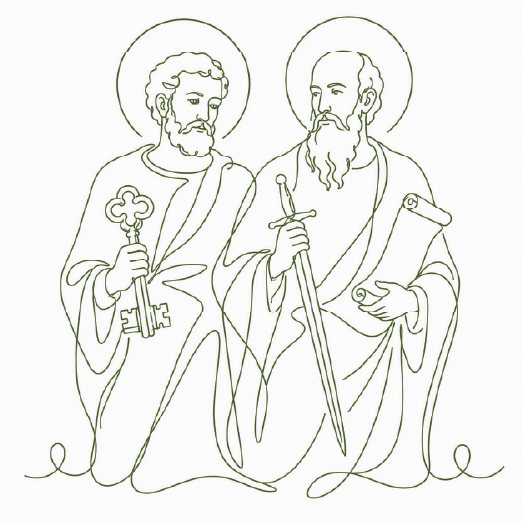
Saint Peter and Saint Paul
Saint Peter and Saint Paul hold a unique place in the history of the Church.
Despite their differences in personality, background, and gifts, both dedicated their lives to proclaiming Christ and became the great pillars of the Christian community.
Peter reminds us of trust in God and of a faithfulness that endures even after failure. Paul reminds us of the power of conversion and the courage to follow God's call along unexpected paths.
We have chosen them because they show us that communion does not require uniformity. On the contrary, God makes use of our differences to build something greater.
Marriage, too, brings together two people with different stories, sensitivities, and talents, calling them to become one family. Unity does not arise because husband and wife are the same, but because they place Christ at the centre of their lives.
As we invoke Saint Peter and Saint Paul, we ask for the grace to grow in unity, fidelity, and the shared mission that God entrusts to us.
May they help us to build a marriage founded upon Christ, so that our threefold cord may remain strong throughout our lives.
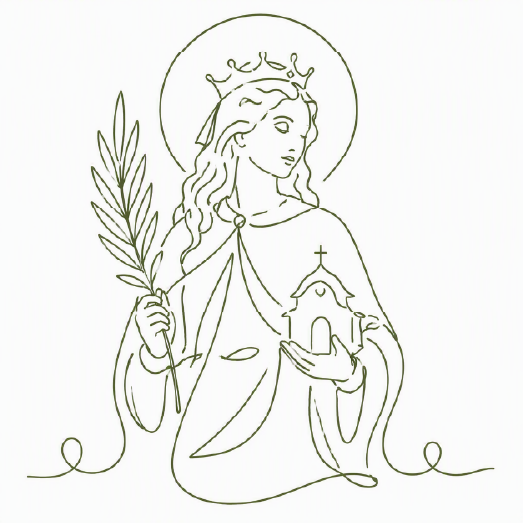
Saint Quiteria
Saint Quiteria is the patron saint of the Basilica where we will celebrate our wedding.
For this reason, her presence in our Litany is not merely devotional; it is deeply connected to the place where we will pronounce our “I do”.
Tradition presents Saint Quiteria as a young martyr, steadfast in faith and courageous in the face of adversity. Her life reminds us that following God requires conviction, fidelity and trust, even when it means choosing difficult paths.
In invoking her, we ask her to protect this day and the journey that will begin from it. May Saint Quiteria, patron saint of the Basilica of Santa Quitéria de Meca, intercede for us, so that the place where we will celebrate the Sacrament of Matrimony may always remain in our memory as a sign of faith, commitment and grace.
Saint Quiteria reminds us that our marriage does not begin simply in a beautiful or historically significant place. It begins in a place of faith, where we wish to entrust our shared life to God.
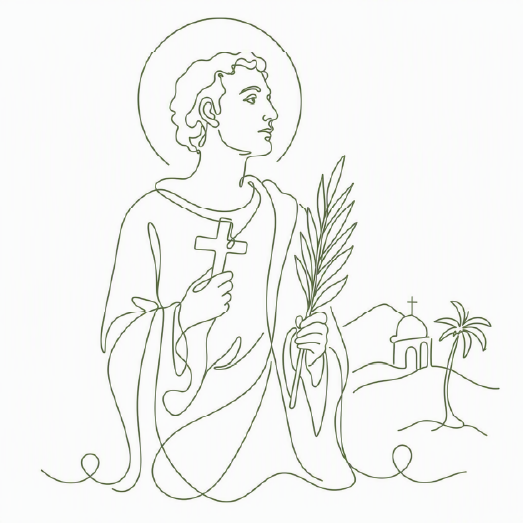
Saint Arethas
Saint Arethas was a Christian martyr of the Arabian Peninsula, associated with the ancient Christian community of Najran.
His presence in our Litany bears a very special connection to our life today. Living in Saudi Arabia, we feel that his story reminds us of the ancient and courageous presence of Christians in this region of the world.
Saint Arethas bore witness to his faith in a difficult context and remained faithful to Christ until the end. His life reminds us that faith is not always lived in easy circumstances, but that fidelity to God can flourish even in unexpected places.
In invoking him, we ask for the courage to live our faith with authenticity, humility and steadfastness. May he help us remember that God is present not only in familiar places, but also in distant lands, new paths and the situations in which we are called to trust more deeply.
In our threefold cord, Saint Arethas reminds us that faith is a source of strength that sustains us, even when the path requires courage.
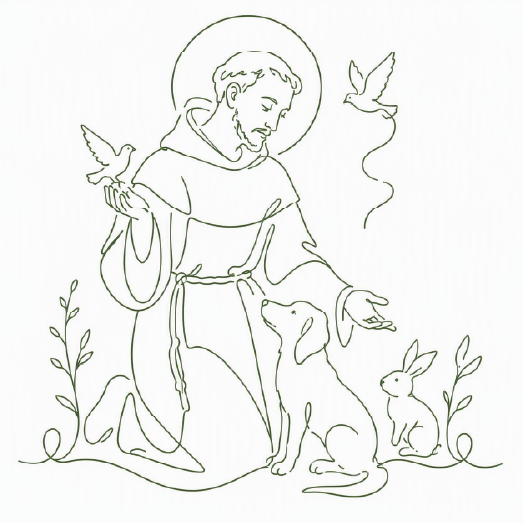
Saint Francis of Assisi
Saint Francis of Assisi is one of the most beloved saints of the Church. His life was marked by simplicity, joy, love for the poor, and a profound communion with all of creation.
He is often remembered for his love for animals and for the way he saw in every creature a reflection of God's goodness.
His presence in our Litany holds a special meaning for us. As a veterinarian, Diogo dedicates his professional life to caring for animal health and finds in Saint Francis an example of respect, stewardship, and gratitude for all of creation.
But Saint Francis speaks to us about more than animals. He speaks to us of an entire way of living: simpler, more grateful, freer, and more attentive to God's presence in the little things.
In invoking him, we ask for the grace to live our marriage with joy, simplicity, and a commitment to caring for the creation that God entrusts to us.
May Saint Francis help us build a life in which love is expressed also through respect for nature, for animals, and for everything that God has created.
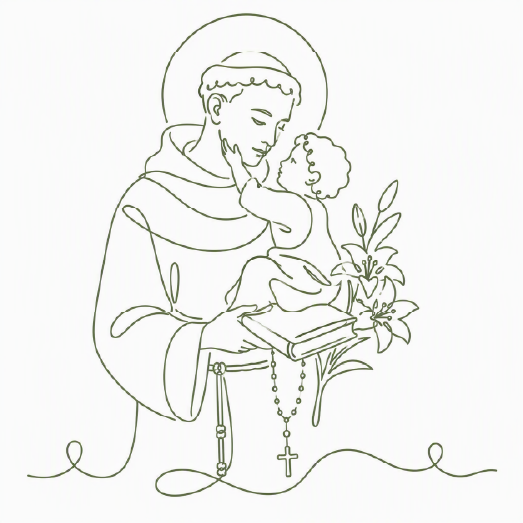
Saint Anthony of Lisbon
Saint Anthony of Lisbon is perhaps one of the most beloved saints of the Portuguese people.
A Franciscan friar, preacher, and profound scholar of the Scriptures, he dedicated his life to proclaiming the Gospel and bringing people closer to Christ.
His presence in our litany also represents our Portuguese roots. Saint Anthony is part of the faith lived by ordinary people, of our traditions, our celebrations, and the simple and familiar way in which many Portuguese have learned to relate to God.
But Saint Anthony is not only the popular saint associated with miracles and lost objects. He is also a great teacher of the Word of God and a remarkable example of love for Christ.
As we invoke him, we ask that he help us to listen more attentively to God's Word, to live our faith with simplicity, and never to lose the ability to seek God in the ordinary moments of daily life.
May Saint Anthony of Lisbon accompany our marriage and always remind us of our roots, our homeland, and the faith that we have received.
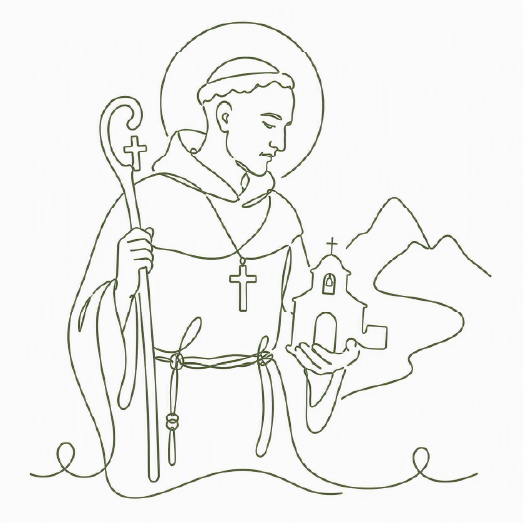
Saint Junípero Serra
Saint Junípero Serra was a Franciscan missionary who left his homeland to proclaim the Gospel in distant lands.
His life was marked by the courage to set out, trust in God, and a willingness to build communities of faith in new places.
His presence in our litany also carries a beautiful personal connection: the Church celebrates Saint Junípero Serra on 1st July, the day of Sara's birthday.
As we invoke him, we ask for the grace to keep our hearts open to God's plans, even when those plans lead us along unexpected paths. Just as he crossed borders to fulfil his mission, we too were called to leave Portugal and begin a new chapter of our lives far from home.
Saint Junípero reminds us that the Christian life is always a journey. We do not always know exactly where God is leading us, but we can trust that He walks beside us.
In our marriage, we ask him to help us embrace every change as a mission, every new beginning as an opportunity, and every new path as a place where God can help our love to grow.
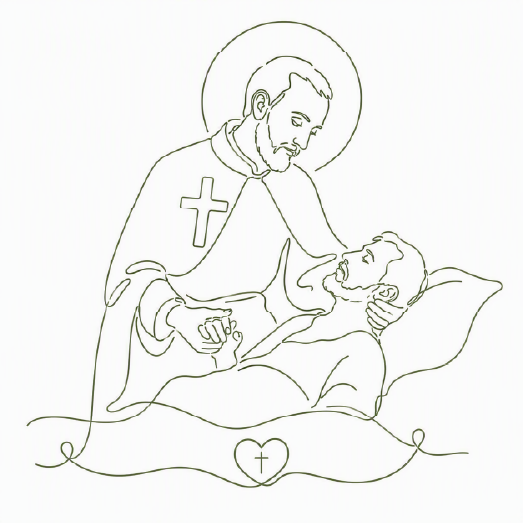
Saint Camillus de Lellis
Saint Camillus de Lellis devoted his life to caring for the sick, the vulnerable, and those who were suffering.
At a time when hospitals were often places of neglect, Saint Camillus taught that every sick person should be cared for with dignity, tenderness, and love, as if Christ Himself were present in them.
His presence in our litany carries a particularly special meaning because of Sara's vocation as a nurse. His example reminds us of the beauty of a life placed at the service of others, especially those who are experiencing moments of vulnerability, pain, or need.
But Saint Camillus also speaks to our married life. Marriage is a vocation of mutual care, especially in the moments when we are most vulnerable. The promises we will make on this day include loving one another not only in health, but also in sickness; not only on easy days, but also on difficult ones.
As we invoke Saint Camillus, we ask for the grace to care for one another with patience, compassion, and generosity. May he teach us to recognise God's presence in every act of service and remind us that true love is often revealed through the small acts of care that shape everyday life.
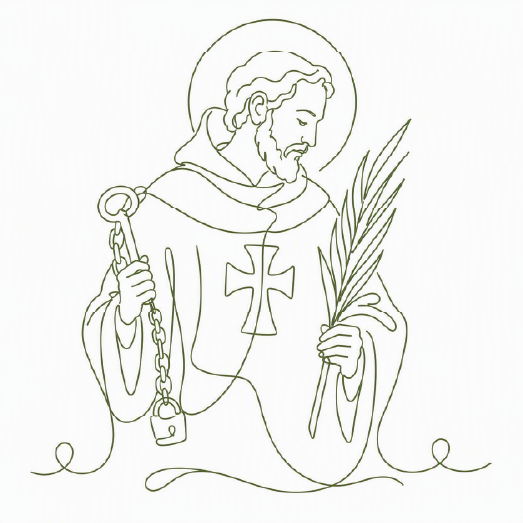
Saint John of Matha
Saint John of Matha was the founder of the Order of the Most Holy Trinity, dedicated in a particular way to the liberation of Christians living in captivity.
His presence in our litany carries a special meaning because he is one of the saints we came to know through our experience of living the faith in Saudi Arabia.
His life speaks to us of freedom, redemption, and trust in God. He reminds us that Christ came to set us free from all that holds us captive: fear, selfishness, sin, loneliness, and the loss of hope.
Within the context of our marriage, Saint John of Matha reminds us that true love never imprisons. On the contrary, it helps each person become more free, more complete, and closer to God.
As we invoke him, we ask for the grace to grow in interior freedom, placing Christ at the centre of our lives and allowing our love always to be a place of growth, trust, and self-giving.
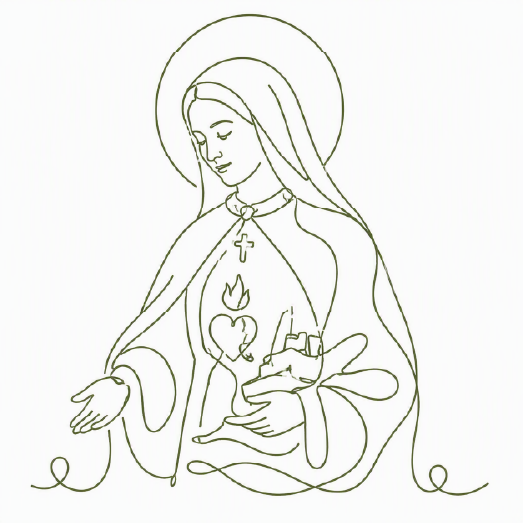
Saint Frances Cabrini
Saint Frances Cabrini was a woman of tireless faith, a missionary, and the founder of the Missionary Sisters of the Sacred Heart of Jesus. She devoted much of her life to caring for migrants, especially those who had left their homeland in search of a new life, often facing loneliness, uncertainty, and great challenges.
For this reason, she is recognised as the patron saint of migrants and immigrants.
Her presence in our litany carries a particularly special meaning for us. By coincidence—or perhaps by providence—Saint Frances Cabrini is celebrated by the Church on 22nd December, the very day our story began.
But her connection to us goes even further. We also left Portugal and were called to build an important part of our lives in Saudi Arabia, far from our homeland, our families, and many of the familiar points of reference that had always surrounded us.
As we invoke her, we ask for her intercession, that we may never lack courage in times of change, trust in new beginnings, and the ability to make a home wherever God may lead us.
May Saint Frances Cabrini help us to live our marriage as a mission: carrying with us faith, love, and hope, even when the road leads us far from home. In our threefold cord, she reminds us that God also walks with us through departures, arrivals, and every place we learn to call “home”.
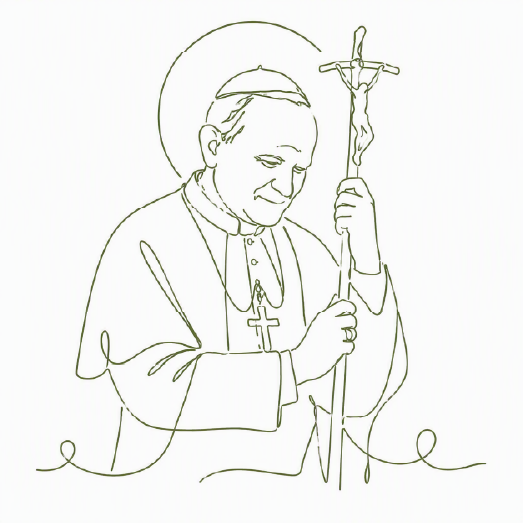
Saint John Paul II
Saint John Paul II devoted an important part of his pontificate to reflecting on human love, the body, the family, and marriage.
Through his teaching and personal witness, he helped many couples rediscover the beauty of the vocation of marriage as a path to holiness.
We have chosen him because he reminds us that the love between a man and a woman is not merely a human reality, but also a spiritual vocation. In marriage, husband and wife are called to love freely, totally, faithfully, and fruitfully.
Saint John Paul II helps us to see our “I Do” as something greater than a romantic promise. It is a gift of one's whole life. It is a daily choice. It is a journey in which body, soul, faith, and freedom are united in response to God's call.
As we invoke him, we ask that he help us to understand ever more deeply the greatness of the sacrament we are about to celebrate and to live our love as a visible sign of God's love.
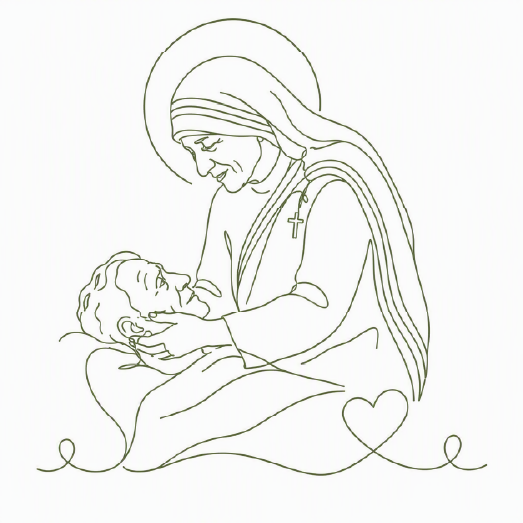
Saint Teresa of Calcutta
Saint Teresa of Calcutta devoted her life to serving the poor, the sick, the abandoned, and those who were often forgotten by the world.
Her holiness was not built through great speeches, but through small acts of love repeated day after day.
Her presence in our litany reminds us that Christian love is not merely a beautiful idea. It is concrete. It touches. It cares. It serves. It draws near to those who suffer.
We have chosen her because we want our marriage not to be closed in upon itself, but to be open to others. The love of a Christian couple is called to overflow, becoming hospitality, attentiveness, service, and compassion.
Saint Teresa also speaks to our concern for the elderly and the most vulnerable. She reminds us that every person possesses immense dignity, even when the world no longer recognises it.
As we invoke her, we ask that she teach us to love through simple and concrete acts, especially those who are most in need of care, presence, and tenderness.